

Retail has spent the better part of the last decade debating the future of physical stores. Yet as digital commerce continues to evolve, one reality has become increasingly clear: customers still crave meaningful in-person experiences.
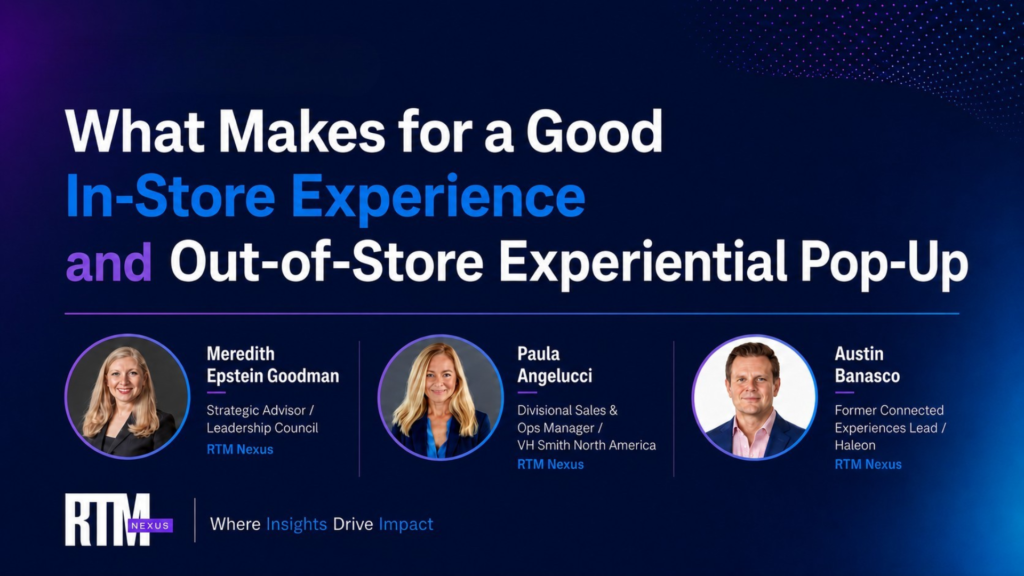
During a recent RTM Nexus Leadership Council discussion, we brought together moderator Meredith Epstein Goodman, retail veteran Paula Angelucci and marketing executive Austin Banasco to explore what separates memorable retail experiences from forgettable ones.
Before diving into the conversation, Goodman introduced an important distinction that framed the discussion.
“I would like to kick it off by differentiating between experience and experiences,” she explained, noting that while the conversation would focus primarily on experiences, “you cannot have good experiences without good experience.”
It’s a subtle but powerful distinction. A retailer can create an impressive activation, host an engaging event, or launch an innovative pop-up, but if the underlying customer experience is poor, those moments lose their impact. The strongest brands understand that memorable experiences are built on a foundation of consistently great service, operations, and customer engagement.
That foundation became a recurring theme throughout the conversation.
Experience Is No Longer Optional
Consumers today expect more from retail environments than shelves filled with products.
According to Paula Angelucci, whose retail leadership career includes Macy’s, Victoria’s Secret, Adore Me, Burlington, and WHSmith North America, the best retail experiences are often built into the DNA of the brand itself.
“When I think about what makes a great evergreen customer experience, some things are really just baked in,” she explained.
Whether it’s personalized bra fittings at Victoria’s Secret, beauty consultations at Sephora, concierge and clienteling programs, guided product discovery, or personalized styling appointments, successful brands create experiences that go beyond transactions.
Angelucci pointed to retailers that have transformed stores into destinations through hospitality, personalization, and immersion. Experiences like Aritzia’s in-store cafés, Nespresso’s flagship retail concepts, and Gymshark’s activations create moments customers remember long after they’ve left the store.
“Everyone has recognized that the store is an opportunity to build a memorable customer experience,” she said.
These experiences succeed because they offer something consumers can’t easily replicate online.
People Remain the Most Important Part of the Experience
While technology often dominates conversations about retail innovation, Banasco believes the most important element remains surprisingly simple.
“Great evergreen in-store experiences really start with the people.”
Whether they are sales associates, brand ambassadors, or client advisors, frontline employees shape customer perceptions every day.
“They’re a representation of your brand and what you’re trying to sell or service,” Banasco explained.
Educating store teams and ensuring they understand both the product and the customer is critical.
“Making them really knowledgeable about your products or services is such an incredibly important piece of the puzzle.”
That impact happens almost immediately.
“They can define whether or not that experience is going to be favorable or unfavorable in a split second.”
In an era where customers often arrive armed with extensive product research, human interaction has become one of retail’s most valuable differentiators.
Creating Experiences Customers Can’t Forget
The best retail experiences don’t simply tell customers about a product—they allow them to experience it firsthand. Banasco shared one of the most memorable examples from his time at Canada Goose: the brand’s Cold Room experience. The immersive installation allowed shoppers to step into a simulated extreme-weather environment and test jackets in the conditions they were designed for.
“It was authentic, it was on brand, and it was built for purpose.”
The concept perfectly illustrates what Banasco believes great experiences should accomplish.
“The best in-store experiences do what advertising can’t. They let you feel it.”
He pointed to other examples including Dyson’s live demonstrations, Nespresso’s flavor trials, and LEGO’s build stations. Each experience creates engagement that customers remember and talk about.
“It doesn’t always have to be discounts or earn-and-burn mechanics,” he said. “It can be first access, early entry, curated refreshments, or atmosphere. It just needs to be fit for purpose for your brand.”
The common thread is irreplaceability.
“Every great example earns its place by being something you can’t get online, can’t get from a competitor, and can’t forget.”
The Store Has Become a Marketing Channel
One of the most compelling ideas discussed was the evolving role of the store itself.
“The store is a marketing channel,” Banasco said. “Arguably your highest-fidelity brand expression.”
That perspective changes how retailers think about performance and measurement. Historically, retail success has been measured through metrics like conversion rate, basket size, average transaction value, and units per transaction. Those metrics remain important, but experiential retail requires a broader view. Banasco highlighted qualitative metrics such as dwell time, Net Promoter Score (NPS), user-generated content, and CRM capture as increasingly valuable indicators of success.
“The KPI should reflect the business outcome you’re trying to achieve,” he explained.
A luxury retailer may prioritize engagement and relationship-building, while a convenience-driven retailer may focus more heavily on conversion and speed.
His advice was simple:
“Test, test, and test.”
Rather than relying on intuition alone, brands should evaluate experiences through controlled testing, identify what resonates with customers, and scale accordingly.
Why Pop-Ups Continue to Work
Few retail formats generate excitement like a pop-up. For Angelucci, the difference between a pop-up and a permanent retail experience comes down to urgency.
“A great pop-up creates urgency, cultural relevance, and social currency in a compressed moment, while an in-store experience has to deliver consistently every day.”
Brands such as Rhode, Glossier, and Skims have mastered the formula by combining immersive environments, exclusive product offerings, and highly shareable moments. But Angelucci cautioned against judging success solely by the length of the line outside.
“I don’t think long lines alone mean an activation is successful.”
The real value lies in what happens after the visit.
“The strongest pop-ups feel authentic to the brand story, engage multiple senses, create discovery, and leave customers feeling like they participated in something they couldn’t get anywhere else.”
One example she highlighted was Rhode’s SoHo pop-up. The activation generated enormous buzz, but its success went far beyond giveaways. The environment served as an immersive extension of the brand, complete with curated photo opportunities, limited-edition merchandise, experiential product discovery, and social-first design.
“It turned a temporary installation into long-term brand amplification.”
For Banasco, pop-ups serve another purpose entirely.
“At Canada Goose, pop-ups weren’t experiential marketing. They were strategic infrastructure.”
Before opening permanent locations, the company used pop-ups to test demand, validate market opportunities, and gather real-world consumer insights.
“The result was lower risk, faster learning, and a capital decision backed by data, not intuition.”
The Future Is Omnichannel
One of the clearest themes from the discussion was that consumers no longer distinguish between online and offline shopping. They simply expect a seamless experience.
Angelucci saw this firsthand while leading store expansion efforts at Adore Me, a digitally native brand that later entered physical retail. The challenge was ensuring that the in-store experience matched the sophistication and convenience customers already expected online.
“You can’t function as two separate entities.”
Loyalty programs, promotions, product information, and customer service all need to work together as part of one connected journey. Banasco agreed.
“The line between physical and digital is almost gone at this point.”
Consumers frequently move between channels during a single shopping journey, researching products online while standing in stores and interacting with brands across multiple touchpoints before making a purchase.
He described how Canada Goose transformed in-store interactions into long-term digital relationships.
“A customer tries on a jacket in the Cold Room, and that moment triggers a personalized follow-up sequence across email and SMS.”
Similarly, during his time at Haleon, digital campaigns tied to Canada Soccer extended into retail environments, creating a single connected customer journey.
“The campaign drove consumers from a digital brand moment into a physical purchase environment. One connected journey, not two separate executions.”
Personalization Is the New Loyalty
Another theme repeatedly surfaced throughout the discussion: personalization.
Today’s customers expect brands to understand their preferences, anticipate their needs, and provide relevant experiences. At NRF earlier this year, Angelucci noted that personalization and loyalty were among the industry’s hottest topics. She pointed to Ulta Beauty as one of the strongest examples.
“Ulta has one of the best loyalty programs out there.”
The retailer has created an ecosystem that combines rewards, personalized offers, app engagement, and product discovery in ways that keep customers returning.
The result is a relationship that feels more meaningful than a traditional points program. For retailers, personalization is increasingly becoming the foundation of loyalty.
The Most Successful Experiences Feel Effortless
One question Meredith Epstein Goodman posed to the panel was whether truly evergreen experiences still exist. The answer from both speakers was yes—but only if they’re rooted in something deeper than a campaign or activation.
Angelucci believes the strongest experiences are built around universal human drivers.
“Personalization, ease, discovery, hospitality, and human connection.”
The foundation remains consistent, while merchandising, storytelling, technology, and product launches evolve around it. Banasco described it differently.
“Every retail brand should aspire to an experience so embedded in its cultural identity that it stops feeling like a program. It just feels like them.”
Whether it’s a loyal customer being recognized by name, the Canada Goose Cold Room, or the atmosphere created before a shopper even touches a product, consistency is what matters most.
“Evergreen isn’t a format,” he said. “It’s a feeling that keeps showing up—reliably, recognizably, yours.”
The Magic Still Happens in the Store
As the conversation came to a close, both speakers returned to a common theme: retail success ultimately comes down to creating meaningful moments that customers remember. For Angelucci, that means getting out into stores and seeing those moments firsthand.
“The magic happens in the stores.”
For Banasco, it means building experiences that become part of a brand’s identity rather than a temporary campaign. And for Meredith Epstein Goodman, it circles back to the distinction that opened the discussion. Great experiences cannot exist without a great experience.
The retailers that thrive in the years ahead won’t be the ones chasing every trend or technology. They’ll be the brands that understand how to blend human connection, thoughtful design, operational excellence, and omnichannel convenience into something customers genuinely value.
Physical retail isn’t disappearing. If anything, it’s becoming more important than ever.
Click here to view the full replay: https://youtu.be/Mu6gXoP-abE