


Early in my executive career, I believed leadership was about speed and execution. When a problem
arose, my instinct was simple: step in, take the wheel, and solve it. It was fast, effective, and got immediate results.
Or so I thought.
Over time, as I navigated senior leadership roles and spent years sitting in rooms with board members,
advisors, and cross-functional teams, I realized that “doing it yourself” is one of the most deceptive traps in business. Regardless of your industry, when a leader steps in to finish a deliverable, override a
strategy, or bypass a team member because it is “faster,” it deflates high-performing people. It subtly
signals a lack of trust and deprives rising leaders of the exact learning experiences they need to grow.
Learning to trade immediate control for deliberate patience and active listening was one of the
hardest—and most transformative—lessons of my career. It is an observation that applies universally,
whether you are managing a small department or advising an enterprise board.
The Boardroom Realization: Mind the Knowledge Gap
For years, I found myself falling into a familiar, frustrating cycle: spending the first half of nearly every
quarterly board or committee meeting just bringing members up to speed.
In day-to-day operations, executive teams spend months living deeply in the weeds—navigating
operational headwinds, complex stakeholder dynamics, market shifts, and granular project execution.
We live in that reality 24/7.
Then, we walk into a boardroom or high-level advisory meeting expecting immediate, high-level
strategic guidance. Instead, we encounter blank stares, basic questions, or unexpected pushback. I used to watch members of executive teams get visibly frustrated, rolling their eyes or pushing back
defensively when advisors didn’t instantly grasp the situation.
One day, I took a step back and looked at the dynamic objectively: Board members and external advisors do not see what we see every single day.
While operators are immersed in the day-to-day work, board members and advisors operate at 30,000
feet, often balancing multiple organizations, oversight responsibilities, or external ventures. The
disconnect wasn’t a lack of intelligence on their part or poor preparation on ours—it was a natural
asymmetry of information. Expecting them to jump straight into complex, strategic decision-making
without warming up was our error, not theirs.
The “Review-First” Blueprint
Once I stopped letting that context gap frustrate me, I changed our approach. We developed a
structured, three-step meeting cadence designed to bring advisors up to speed smoothly while
preserving time for actual strategic debate:
Step 1: Context & Review Mode (First 15–20 minutes) — Start with a tight, distilled review of recent
progress, core operational context, and key environmental shifts. Normalize this brief context-setting as
a foundational ritual rather than a nuisance or interruption.
Step 2: Issues & Strategic Solutions (Core 60 minutes) — Pivot directly from what happened to where we go next. Frame 2–3 core strategic forks in the road—such as major resource allocation choices or long-term growth initiatives—and lean into the board’s collective wisdom to evaluate trade-offs.
Step 3: Setting the Stage for the Next Cycle (Final 10 minutes) — Conclude by defining what success looks like over the upcoming 90 days. Lay out the key focus areas so advisors leave with clear context for what to monitor before the next gathering.
Real-World Leadership Applications
This shift from “doing” to “guiding” pays immediate dividends across every operational scenario:
Scenario 1: Empowering a Project Team
- The Situation: A department lead is struggling to hit project milestones or resolve a cross-functional bottleneck.
- The “Doing” Pitfall: The leader steps in, takes over the work, and dictates the solution. This crushes project manager ownership and leads to disengagement.
- The “Guiding” Approach: Asking thoughtful, probing questions during regular check-ins (“Where is the friction in this workflow?” or “What single decision is holding this back?”) to help the team diagnose and solve the bottleneck themselves. The team builds capability and owns the outcome.
Scenario 2: Aligning Stakeholders on Major Capital Spending
- The Situation: Pitching a significant strategic pivot or multi-year investment to a cautious board or steering committee.
- The “Doing” Pitfall: Diving straight into complex ROI projections and detailed operational metrics
without setting foundational market context. - The “Guiding” Approach: Starting with a clear review of how market dynamics have shifted and why status quo operations carry hidden risk. By establishing the “why” first, stakeholders quickly understand the big picture, leading to constructive dialogue and alignment.
The Leadership Continuum
Whether you are coaching a direct report on your team or managing up to a board of directors, the
overarching principle remains identical: Guide the path, don’t walk it for them.
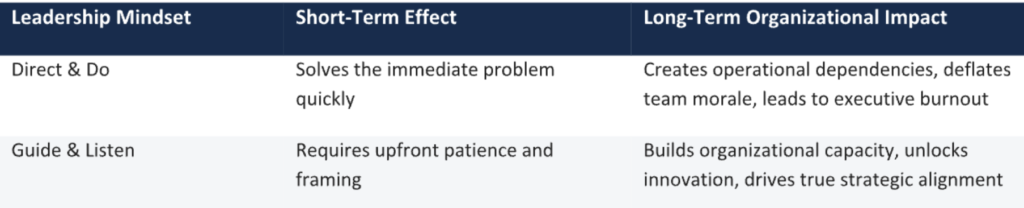
Patience is not passive waiting; it is an active investment in governance, team development, and
organizational maturity. The best leaders don’t let context gaps frustrate them—they leverage patience
and structured communication to turn natural misalignment into a shared strategic advantage.