

One of the biggest misconceptions about entrepreneurship is that successful founders have a clear vision from day one. They don’t.
In fact, some of the most successful companies began with the wrong idea entirely.
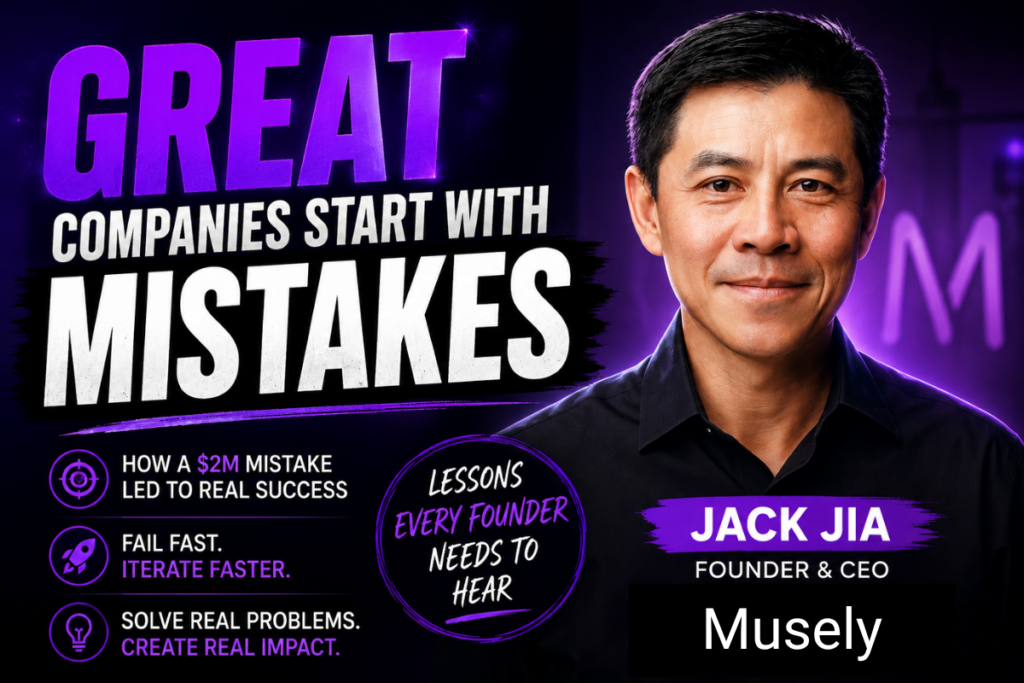
Recently, I had a conversation with Jack Jia, Founder of Musely whose company spent nearly two years and more than $2 million pursuing what ultimately turned out to be the wrong opportunity. Most organizations would view that as a disaster. He viewed it as tuition. That perspective stuck with me.
Too often, we celebrate the outcome while ignoring the process that made it possible. We see the successful product launch, the funding announcement, or the market traction and assume the path was linear. The reality is usually far messier.
Jia described his company’s culture using a simple phrase: fail fast, iterate fast. It’s a concept we’ve all heard before, but what struck me was how deeply embedded it was within the organization. New hires are taught from day one that failure isn’t an exception—it’s part of the job.
He argued that most successful startups don’t overcome one or two obstacles. They overcome hundreds. That’s an important lesson for leaders in any industry.
Whether you’re building a company, launching a new product, transforming a retail organization, or navigating a career change, progress rarely comes from getting everything right the first time. It comes from developing the ability to recognize when something isn’t working, adapt quickly, and continue moving forward.
The conversation also highlighted something equally important: innovation often begins with asking simple questions.
Jia’s original motivation came from a deeply personal challenge. His wife had spent years searching for solutions to a skin condition that countless products promised to address but never truly solved. Like many entrepreneurs, he wasn’t driven by market research or trend reports. He was driven by curiosity.
Why wasn’t this problem being solved?
That question eventually led him into an entirely new industry—one where he had no formal background or experience. Too often, we assume expertise is the prerequisite for innovation. Sometimes the opposite is true.
People who come from outside an industry often see problems that insiders have learned to accept. They ask questions that seem obvious but uncover assumptions everyone else overlooks. That’s the power of first-principles thinking.
Instead of accepting how things have always been done, first-principles thinkers break a problem down to its most fundamental truths and rebuild from there. Innovation doesn’t always start with a breakthrough idea. Sometimes it starts with a willingness to challenge what everyone else assumes is true.
But curiosity alone isn’t enough.
When the conversation shifted to hiring and leadership, another theme emerged: passion and problem-solving matter more than experience.
When evaluating talent, he explained that he places surprisingly little emphasis on industry expertise. Instead, he looks for two qualities: drive and the ability to identify problems. Knowledge can be learned. Industries change. Technology evolves. But the desire to solve problems and the willingness to pursue them relentlessly are far more difficult to teach.
It’s a perspective that challenges many traditional hiring practices. Resumes can tell us where someone has been, but they don’t always tell us how someone thinks.
The most valuable people in any organization are often those who consistently notice opportunities others miss. They ask better questions. They challenge assumptions. They remain curious when everyone else becomes comfortable.
As leaders, our responsibility isn’t simply to manage performance. It’s to create environments where that curiosity can thrive. That means giving people permission to experiment, permission to fail, permission to learn, and perhaps most importantly, permission to change direction when new information emerges.
The truth is that innovation rarely comes from certainty. It comes from exploration.
The companies that win tomorrow won’t necessarily be the ones with the most resources, the most experience, or the most polished plans. They’ll be the ones willing to challenge assumptions, embrace discomfort, and remain relentlessly focused on solving meaningful problems.
The path may not be pretty. It may include dozens—or even hundreds—of setbacks along the way.
But as every successful founder eventually learns, the goal isn’t to avoid failure. The goal is to learn from it faster than everyone else.
Watch the Full Discussion here
About Musely:
By connecting patients with board-certified physicians through a streamlined digital platform, Musely makes it easier to access personalized treatments without the barriers of traditional in-person care. From skincare and hair health to broader wellness offerings, the company combines medical expertise, technology, and convenience to help patients take control of their health from the comfort of home.
https://www.musely.com