

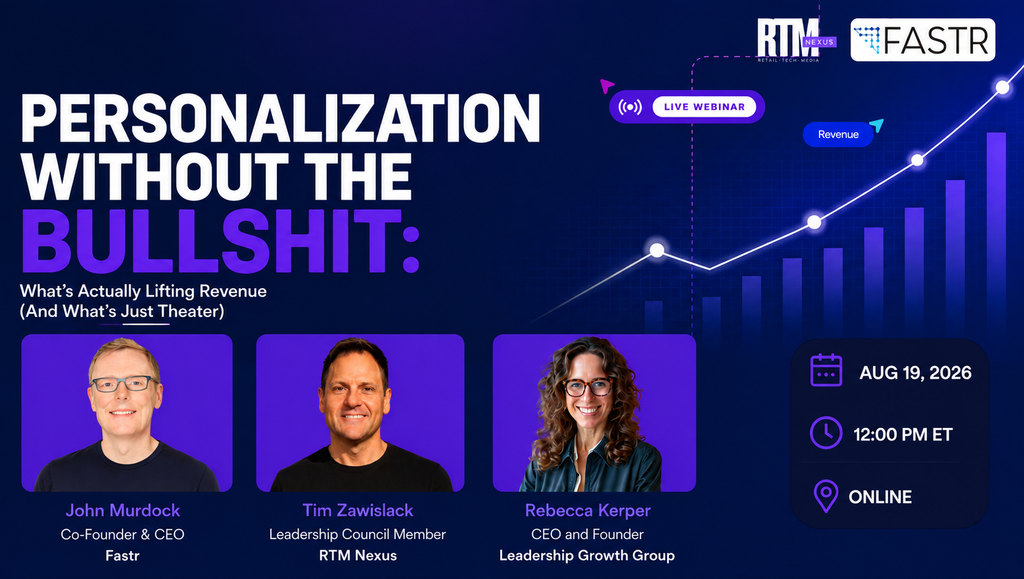
For more than a decade, enterprise brands have invested heavily in personalization. Customer data platforms, recommendation engines, audience segmentation tools, dynamic content systems, and AI-powered experiences have become standard components of the modern retail technology stack. Yet despite billions of dollars in investment, many organizations still struggle to demonstrate meaningful incremental revenue from these efforts.
That disconnect was the central focus of a recent discussion between RTM Nexus Leadership Council Member Tim Zawislack, former HSN Chief Digital Officer Rebecca Kerper, and Faster CEO John Murdock. Their conversation challenged one of the retail industry’s most persistent assumptions: that more personalization technology automatically leads to better business outcomes.
Instead, the panel argued that the biggest obstacles aren’t technological at all. The real barriers are organizational structure, outdated operating models, poor execution, and a misunderstanding of what customers actually want.
The discussion revealed a powerful truth: personalization succeeds when it strengthens customer trust and delivers genuinely helpful experiences. It fails when it becomes what the speakers repeatedly described as “personalization theater.”
The Problem with Personalization Theater
One of the most compelling themes throughout the discussion was the distinction between meaningful personalization and superficial personalization.
Organizations often showcase personalization through visible but low-impact tactics such as homepage banner swaps, generic recommendation carousels, or emails that simply insert a customer’s first name. These initiatives are easy to demonstrate internally, but they rarely create meaningful customer value.
As John Murdock explained:
“Personalization isn’t really personalization. And it doesn’t really connect with the customer.”
Rebecca Kerper shared a simple but memorable example. After frequently ordering from a local pizza restaurant, she received a marketing text promoting a new two-liter bottle of soda. The message technically met the criteria for personalization because it targeted existing customers. However, it wasn’t relevant or valuable.
The issue wasn’t the technology—it was the simplistic rule behind it.
As Kerper observed:
“If you set these generic rules, then you’re going to get generic things back.”
This example highlights a broader industry challenge. Many brands continue deploying familiar personalization tactics because they’re easy to understand, easy to measure, and easy to justify internally. But familiarity doesn’t guarantee effectiveness.
Execution Is the Competitive Advantage
Perhaps the most surprising takeaway from the conversation was that personalization failures are rarely data problems.
Organizations have more customer data than ever before. What they’re missing is the ability to act on that information quickly and effectively.
Rebecca Kerper emphasized that companies often focus heavily on technology integration while neglecting the operating model required to turn insights into action. Organizations become trapped in approval processes, slow decision-making cycles, and rigid structures that prevent rapid experimentation.
As she explained, “Adopting a flexible mindset is really, really important as we commit to some of these changes.”
Murdock echoed this point. “Personalization didn’t fail. The underlying organization structure has been failing.” He argued that many personalization initiatives don’t fail because the strategy is wrong. They fail because execution models were designed for a slower era of retail.
In today’s environment, competitive advantage comes less from collecting data and more from acting on it faster than competitors.
As Murdock summarized: “The winners in today’s era are really not better at data. They’re really faster at execution.”
Trust Is the New Currency
Another major theme that emerged was the growing importance of customer trust.
Kerper introduced the idea that modern commerce is operating in what she called a “trust recession.” Consumers are overwhelmed by products, content, brands, advertising, and digital interactions. Their attention is limited, and so is their willingness to trust.
This creates both a challenge and an opportunity.
Brands that simply collect customer data without delivering meaningful value risk damaging trust. Conversely, brands that use data thoughtfully can deepen relationships and strengthen loyalty.
As Kerper said to articulate the distinction, “It doesn’t feel like they’re watching me. It feels like they understand me and they get me.”
This balance between relevance and intrusion is becoming one of the defining challenges of modern personalization.
Murdock reinforced the importance of responsible data usage, arguing that brands must think strategically about how they collect and activate customer information. The goal should never be personalization for personalization’s sake. The goal is to create stronger relationships and better experiences.
The brands that succeed will be those that earn trust through consistency, transparency, and genuine customer understanding.
The Future Is Behavioral, Contextual, and Human
The conversation also explored how personalization is evolving beyond static customer segments.
Traditional personalization often relies on historical customer attributes. The next generation focuses on real-time behavior and intent.
According to Murdock, the most successful brands are personalizing deeper into the customer journey—not just homepage banners, but search results, category pages, product pages, and discovery experiences. They combine real-time behavioral signals with first-party data to create experiences that feel more relevant and intuitive.
Kerper pushed this idea even further by arguing that understanding behavior alone isn’t enough. “Not only do we have to understand the behavior, we have to understand the anticipated behavior.”
In other words, brands must move beyond what customers are doing and begin understanding why they’re doing it.
Someone searching for a black dress may be shopping for a wedding, a job interview, a formal event, or a vacation. The search term alone doesn’t reveal the customer’s intent.
The future of personalization lies in uncovering and responding to those underlying motivations.
Omnichannel Alignment Is No Longer Optional
Throughout the discussion, both speakers stressed that customers don’t think in channels.
Organizations may separate e-commerce, stores, social commerce, loyalty, marketing, and merchandising into different departments, but customers experience a single brand.
This creates enormous pressure on organizational structures.
Murdock noted that many retailers have historically treated digital and physical channels as competing business units. Increasingly, leading brands are finding success by aligning those channels around a shared customer experience.
Kerper highlighted how roles themselves are changing. Merchants, marketers, and digital teams can no longer operate within narrow functional silos. Modern retail requires a broader understanding of customer behavior across TikTok, social commerce, e-commerce, marketplaces, and physical stores.
As customer journeys become increasingly fragmented, organizational alignment becomes increasingly important.
The brands that win won’t necessarily have the most advanced technology. They’ll be the ones that create seamless experiences across every customer touchpoint.
New KPIs for a New Era
A particularly insightful part of the discussion centered on measurement.
Most retailers still focus heavily on traditional metrics such as sessions, conversion rates, and sales. While those metrics remain important, Kerper suggested that organizations need additional measurements that reflect the realities of AI-driven personalization.
One example she offered was measuring how quickly an organization acts on an insight generated by AI.
This shift represents a broader change in thinking.
Success is no longer defined solely by outcomes. It is increasingly influenced by organizational responsiveness, speed of execution, and the ability to continuously test, learn, and adapt.
The companies that develop these capabilities will be positioned to capture the greatest value from AI and personalization investments.
The Lasting Lesson: Customer Experience Is the Strategy
As the conversation concluded, both speakers returned to a common theme.
Technology will continue to evolve. AI capabilities will improve. New platforms will emerge. Customer expectations will change.
What won’t change is the importance of building genuine customer relationships.
Kerper captured this idea when she reflected on what successful brands consistently have in common: “The brands and the leaders that I work with that are truly at their core successful are the ones who have the deepest connection with the customer.”
Murdock reinforced the same conclusion: “It’s really about the customer and that deep customer experience.”
The future of personalization isn’t about more technology. It’s about using technology to become more human, more responsive, and more trustworthy.
Organizations that focus solely on tools will continue to struggle.
Organizations that focus on trust, customer understanding, operational agility, and meaningful experiences will be the ones that unlock sustainable growth.
And in an increasingly commoditized marketplace, that may be the most important competitive advantage of all.
Visit GetFastr.com for more information