

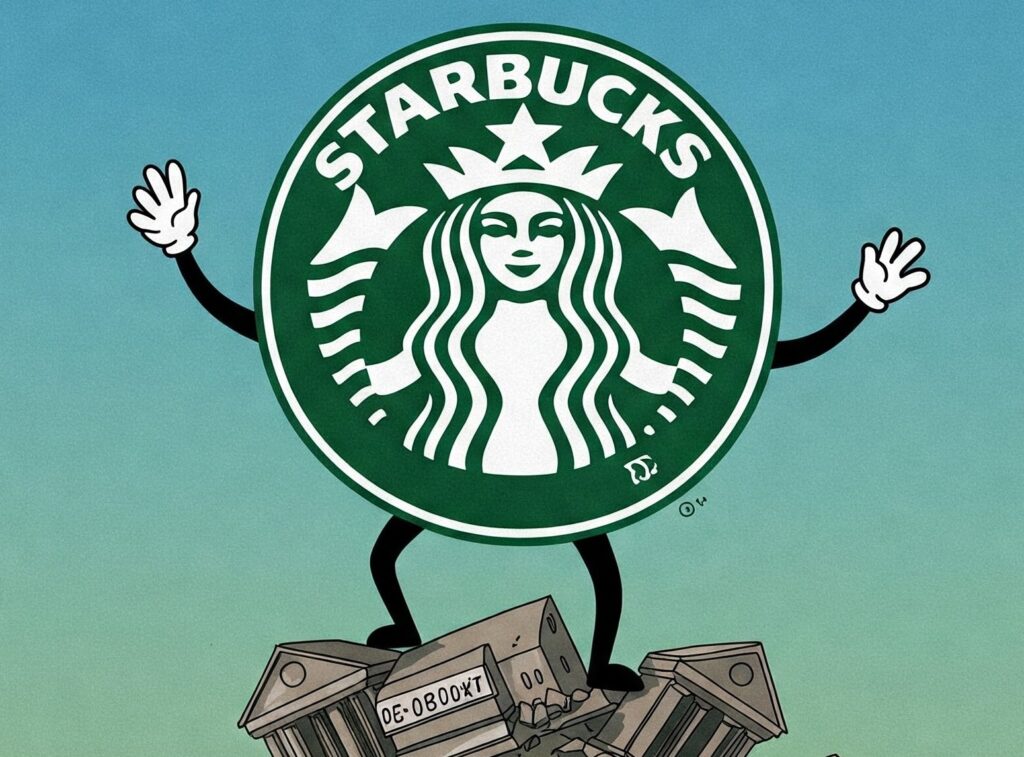
Starbucks has quietly become something far bigger than a coffee chain.
Without most people even realizing it, the company now operates one of the largest prepaid consumer ecosystems in America.
At the close of fiscal 2024, Starbucks reported a stored-value card liability of $1.78 billion. In simple terms, that is money customers already handed Starbucks for drinks and food they have not ordered yet.
That number is staggering when you stop and think about it.
Consumers are voluntarily loading billions of dollars into a coffee company’s app and gift card system before they even decide what they want to drink tomorrow morning. There are very few brands on earth that inspire that kind of routine trust.
To put it in perspective, the United States has roughly 4,500 FDIC-insured banks. Many smaller community banks operate with less than $1 billion in total assets. Starbucks’ unused gift card balances are larger than some local banks entirely.
Now obviously this is not a direct banking comparison. Starbucks is not issuing mortgages or business loans. But the psychology behind it matters because consumers are effectively trusting Starbucks to hold onto their money with almost zero hesitation.
That kind of trust is difficult to build in modern retail.
And Starbucks did not build it with advertising alone.
They built it through habit.
The Starbucks app became part loyalty program, part convenience tool, and part daily ritual. Customers can order ahead, collect rewards, skip the line, customize drinks, and move through their morning routine almost automatically. Over time, the app stopped feeling like a payment platform and started feeling like part of everyday life.
That is what makes this story interesting from a retail and consumer behavior standpoint.
Most companies spend enormous amounts of money trying to create loyalty. Starbucks created a system where consumers willingly pre-fund their future purchases because the experience feels frictionless. That is a completely different level of customer relationship.
And financially, it is incredibly valuable.
Every unused dollar sitting inside the Starbucks ecosystem acts like an interest-free loan from customers. Some balances eventually get spent. Some are forgotten entirely. In accounting, that is called “breakage.” In reality, it is the gift card sitting in a kitchen drawer with $11 left on it that nobody remembers to use.
Multiply that behavior across millions of people and the numbers become enormous.
What Starbucks figured out earlier than most brands is that convenience creates retention. Retention creates habit. Habit creates trust. And once consumers trust the ecosystem enough, they stop thinking about the transaction itself.
That is where modern loyalty programs become much more than marketing tools. They become financial engines quietly operating in the background of consumer life.
In many ways, Starbucks built its own informal currency system powered by caffeine, routine, mobile technology, and consumer psychology.
That is an extraordinary achievement for a company that still fundamentally sells coffee.
So the next time you reload your Starbucks card for a latte, cold brew, or breakfast sandwich, remember what is really happening behind the scenes. You are participating in one of the most successful prepaid retail ecosystems ever created.
Not bad for a coffee company that started with a cup of coffee and a logo.