

By: Hemang Upadhyay, Strategic Product & AI Leader, RTM Insider
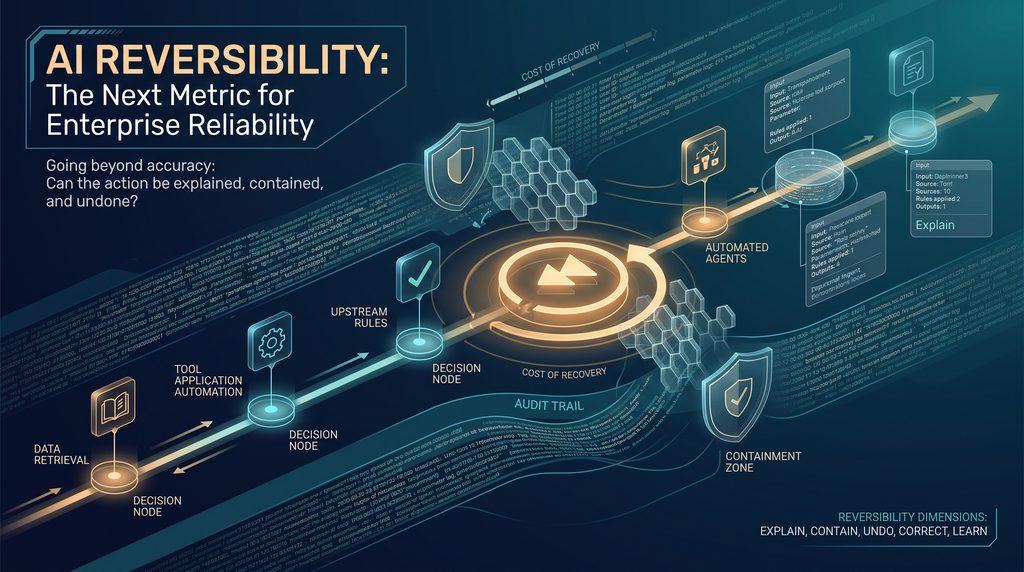
Most AI reliability conversations still fixate on accuracy. Accuracy matters, but for agents that act, it is incomplete. Once an AI system takes action, the sharper question is often whether the action can be reversed.
Reversibility is the ability to explain, pause, undo, correct, or compensate for an AI-influenced action after it happens. It does not replace accuracy. It is a production-readiness property built on a plain truth: some failures will get past testing. If an enterprise cannot contain or reverse the impact of an agent’s mistake, it is not ready to give that agent real autonomy, no matter how impressive the scorecard looks.
The Lesson from High-Velocity Decisioning
I think about reversibility through the lens of high-velocity environments, especially real-time fraud detection and risk forecasting. In real-time decisioning, the system does not get the luxury of infinite review. A transaction is approved, declined, flagged, or routed under pressure. The model’s prediction matters, but the operating design around it, the review queues, audit trails, exception handling, and escalation paths, matters just as much. The higher the velocity, the more important reversibility becomes. That same lesson applies to AI agents acting inside enterprise workflows.
Why accuracy alone misleads
Accuracy is most meaningful when the output is bounded: classify this document, extract this field, summarize this thread. Agents do not live in bounded outputs. They retrieve data, choose tools, apply rules, update records, and set off downstream actions. A 95 percent accurate agent can be unacceptable if the missing 5 percent touches customers, financial records, compliance, or operational commitments. A less accurate agent can be acceptable if every action it takes is visible, reversible, and cheap to correct. Reliability is not only whether the AI was right. It is whether the business can recover
when it is wrong.
The five dimensions of reversibility
Reversibility has layers. Explainability comes first: you have to reconstruct what the agent did, what it used, and why the action looked valid at the time. Containment is next, the ability to pause or limit further actions before a problem spreads. Undo is the direct reversal: cancel a workflow, roll back a record, restore a prior state. Some actions cannot truly be undone, which is where compensation comes in: a customer already saw thewrong price or received the wrong message, so the enterprise needs a defined path to repair the experience. Learning closes the loop, because a recovery that changes nothing simply schedules the next identical failure.
Without that record, investigation stalls at the worst moment. The team can see that something went wrong but cannot say which retrieved value, rule, or tool call produced it.
Let reversibility shape the design
Many agent architectures are built around successful completion. Reversibility asks for a different starting point. Before deployment, classify the agent’s possible actions by consequence. Read-only actions are low risk. Drafting is higher. Writing to enterprise systems is higher still. Actions that reach customers, partners, or money demand the strongest controls.
A commerce example makes the distinction clear. Looking up an order status is read-only and low risk. Drafting a customer email is reversible until someone sends it. Issuing a refund to an external account is a real-world commitment that no rollback fully erases. Same agent, same workflow, three different reversibility requirements. A design that treats them as one bucket either over-restricts the safe action or under-protects the costly one.
Reversibility runs on data contracts
An agent cannot recover from an error if the enterprise cannot reconstruct the context. That requires structured records of inputs, sources, tool calls, decisions, approvals, and outputs. In practice it means data contracts: the agent should know which fields are authoritative, which values are stale, which policies apply, and which actions are permitted. Without those contracts, teams may know an agent failed but never learn why. Fraud decisioning offers a useful analogy: event logs, model outputs, review queues, thresholds, and exception handling. Agentic systems need their own version of that architecture.
‘Human in the loop’ is not the same thing
Plenty of organizations lean on ‘human in the loop’ as a safety phrase. It can help, but it is vague enough to hide the real questions. Who is the human? What are they approving? What do they see? What happens if they approve the wrong thing? Reversibility forces precision. Tie human review to the severity of the action, the confidence level, and the cost of recovery.
A workable start is to inventory an agent’s possible actions and score each on two axes: how cleanly it can be undone and how expensive recovery is if it cannot. Actions that are hard to undo and costly to repair should remain behind human approval. Then track how often the agent takes high-consequence actions, how often those require correction, and how long correction takes. Those numbers tell you whether autonomy is earning its keep.
Before handing an agent more authority, run a short test. Can we explain the action? Can we stop it from spreading? Can we undo it? If not, can we repair the impact? Can we turn the incident into a system improvement? If the answers are no, the agent can still be useful, but its autonomy should stay narrow. The next generation of enterprise AI will be judged by how it behaves in a messy workflow on a bad day. Reversibility tells you, before that day arrives, whether you are ready.