

By: Jiaqi Qian, GP Singh
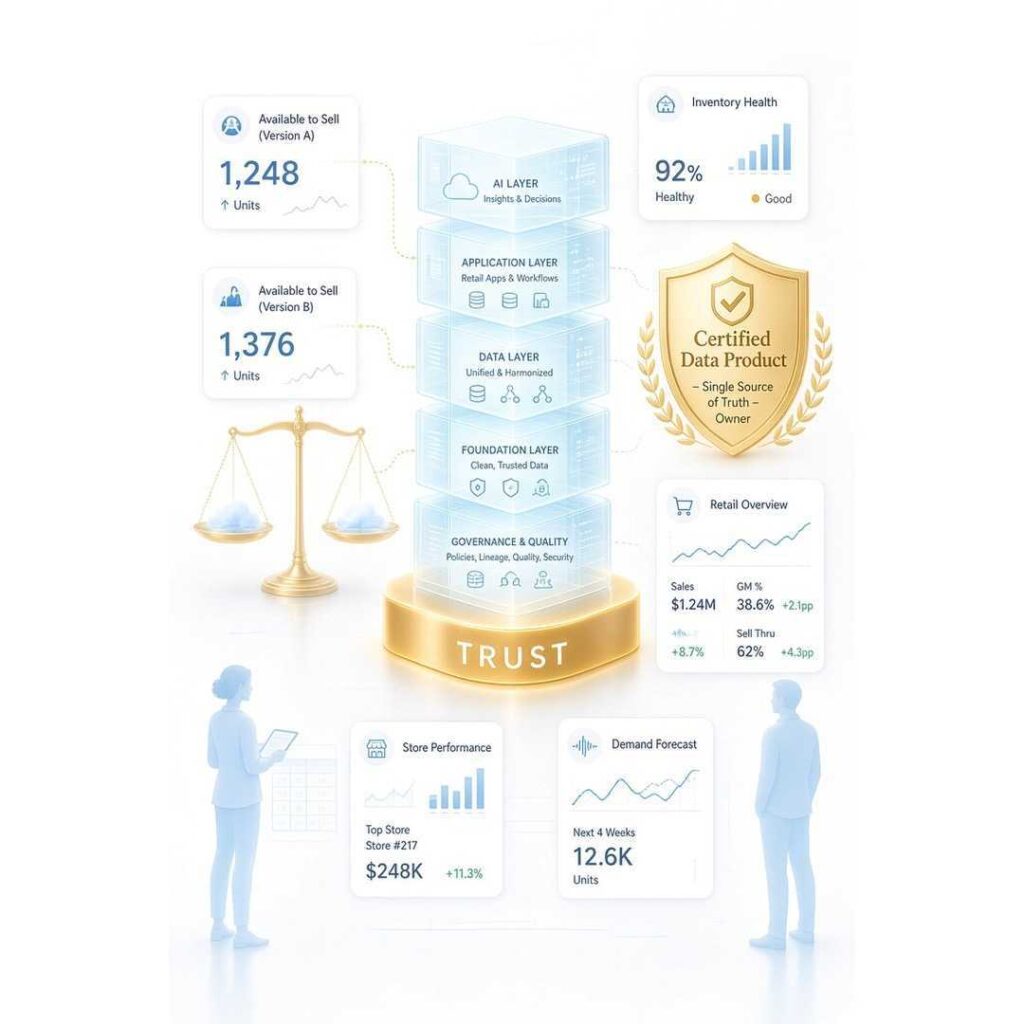
The most expensive failure in retail analytics doesn’t look like a failure.
Dashboards load. Reports ship on schedule. The AI assistant produces fluent summaries. On paper, the program works. Meanwhile the merchandising lead keeps a spreadsheet, the planner calls an analyst she trusts before signing a replenishment plan, and the executive who commissioned the dashboard has stopped opening it.
It’s tempting to say people stopped believing the numbers. More often, they never started. Trust wasn’t lost. It was never earned, because the merchants, planners and finance partners expected to act on it were never part of building it. Solutions designed without them in the room don’t fail at go-live; they fail at buy-in, months earlier.
Trust is the scarcest resource in retail decision intelligence — scarcer than data, engineering capacity, or model quality. It is also the least instrumented. We monitor pipeline uptime, freshness, and model precision. In AIOps, that is infrastructure telemetry, and no one confuses it with service health. The SLO (Service Level Objective) for a decision system isn’t the dashboard rendered. It is: did a decision change, was it right, and can we trace it back to a definition someone owns?
Where brand and retail lose it
Retail loses trust in a specific and unglamorous place: the definition layer.
Ask what “available to sell” means. Finance nets out reserved inventory to protect the revenue number. Merchandising nets it differently to protect the customer promise. The data team, asked to make it computable, writes: on-hand at a node, minus allocated and reserved, minus safety stock, plus inbound arriving inside the promise window, as of the last successful sync. Every version is defensible. None of them agree — and the third is what the model actually sees.
The gap runs two ways. Within the technical estate, two engineers on two stacks implement “available” differently because no data contract says which. Across tech and business, nobody catches it: the planner never saw the SQL, and the engineer was never in the allocation meeting.
For years a human sat between the number and the decision and knew which version to use. AI removes the human from that seat — and it does not fix inconsistent definitions. It amplifies them at machine speed. A confident summary built on an ungoverned metric travels farther than a spreadsheet ever did, and sounds authoritative. When finance rejects it because the numbers don’t tie, the damage isn’t one bad recommendation. It’s that the next twelve are read with suspicion.
The Agent Threshold
The stakes rise when systems move from describing to deciding. The blast radius of a wrong chart is a bad meeting. The blast radius of a wrong autonomous action is inventory sitting in the wrong region for six weeks, supply chain team air freight to address the empty shelf, sales leads stressed out about not meeting the revenue numbers, and executives getting heated calls and trying to explain to the CFO.
The teams doing this well are deliberately unambitious at first. The allocation agent may recommend a transfer between distribution centers; it may not execute one. Anything above a defined threshold routes to a named human. They run that way for two or three quarters, prove recommendation quality, then widen the mandate. Autonomy is paid for in predictability; buy only as much as the problem requires.
What The Leaders Do Differently
The advantage is mundane, and hard to copy:
- One governed definition and one named owner for every decision-driving metric. A person, not a team.
- Definition changes announced before the number moves. An unexplained change is indistinguishable from an error.
- AI features read from certified data products only. What the model may see is settled before what it may do.
- The people who will act on the output helped define it. Adoption is designed in, not trained in afterwards.
None of that is a technology purchase. All of it is an operating decision. Data leaders and executives own the operating decision.
The Better Question
Retail technology conversations used to open with capability. That question is answered. Data leaders/executives now must answer: what has to be true about our data, our definitions, and our operating model before anyone will act on the output?
Trust is a budget, not a byproduct. In retail, where decisions are high-volume, time-sensitive, and expensive to get wrong, it may be the only budget that matters.