

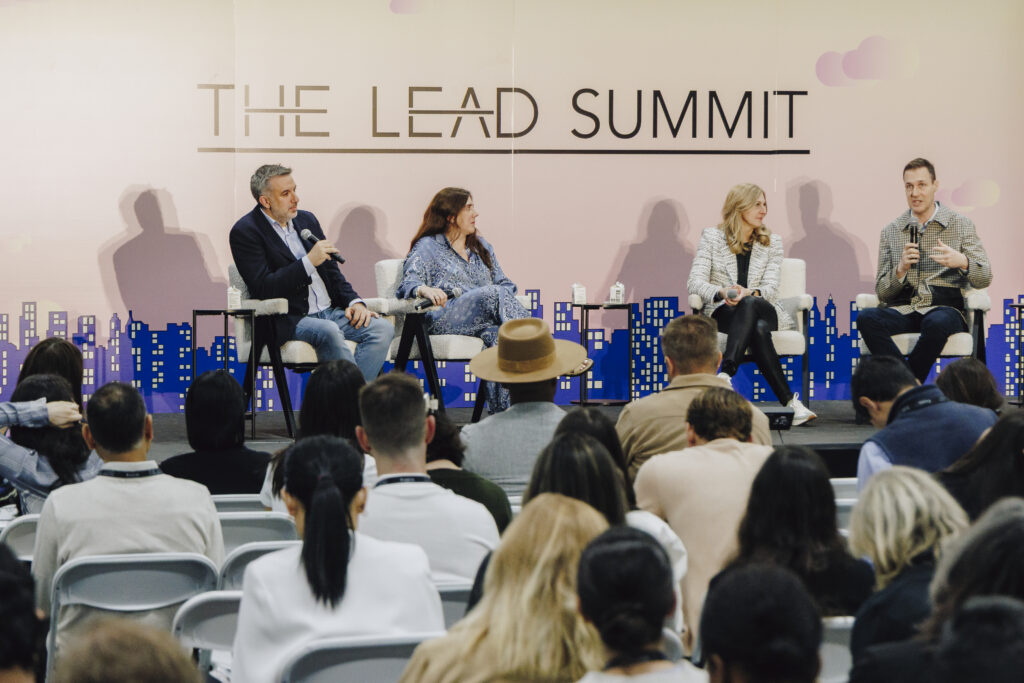
From June 10th to June 12th, The Lead Summit brought together some of the most influential voices across retail, commerce, technology, marketing, and consumer experience in New York City. Across three days of conversations, one message became increasingly clear: retail is no longer just about selling products. It’s about building ecosystems of connection — where experience, hospitality, technology, and community all work together to create long-term customer relationships.
One of the strongest themes throughout the summit was the changing role of physical retail, particularly as brands try to engage younger generations. A panel discussion around Gen Z and the future of malls saw speakers emphasize that “experience” has evolved far beyond superficial activations. As Lee Sterling of Simon Property Group noted, there was a time when experiential retail simply meant “ping-pong tables and flower walls.” Today, consumers expect something far more meaningful.
That shift is redefining what successful retail spaces look like. Brands and property groups are increasingly transforming stores and malls into immersive lifestyle destinations designed around participation, discovery, and emotional engagement. Sephora’s interactive beauty counters have become gathering spaces for younger shoppers. Dick’s House of Sport is integrating rock-climbing walls and baseball fields directly into retail environments. Coach is driving foot traffic through monogram stations and in-store coffee bars. Meanwhile, Netflix House at King of Prussia is reimagining a former Lord & Taylor footprint as a constantly evolving entertainment experience that refreshes every six months based on what’s trending across the platform.
The takeaway wasn’t simply that consumers want entertainment. It’s that physical retail now needs to provide something digital commerce cannot: human interaction, tactile discovery, and memorable shared experiences. As several speakers suggested throughout the summit, stores are no longer purely transactional spaces — they are becoming cultural and social environments.
That idea surfaced again in conversations around multi-generational loyalty and authenticity. Some of the strongest brands today are building relationships that extend across age groups rather than targeting a single demographic. Lynda Fisher of Rowan shared how the company’s piercing studios have transformed a simple service into a meaningful family ritual, with grandmothers, mothers, and daughters often coming in together to celebrate milestones. The emotional connection is part of the brand’s strength. As Fisher explained, “You can’t get pierced online and you never could.” Trust, expertise, and human celebration remain central to the experience.
This concept of multi-generational resonance appeared repeatedly across the summit. Ken Ohashi of Brooks Brothers discussed how customers often first enter the brand during important life moments like starting college or celebrating milestones such as a bar mitzvah. Stephanie Unwin of Veronica Beard noted that different generations increasingly share fashion pieces across families. The brands building lasting relevance are not simply chasing trends — they are embedding themselves into people’s lives and memories over time.
Customer Lifetime Value also emerged as one of the most dominant strategic conversations throughout the event. In several sessions, panelists were asked to choose between customer acquisition and long-term loyalty, and the overwhelming consensus favored lifetime value. Tanya Golešić of Mackage explained how expanding beyond outerwear into seasonless apparel increased purchasing frequency among existing customers. Nilofer Vahora of amika discussed how repeat customers deepen their relationship with the brand by expanding into additional product categories, while executives from Boll & Branch and NEST NEW YORK reinforced the importance of relationship-building as a long-term growth strategy.
That focus on loyalty is also reshaping how brands think about hospitality. Increasingly, retailers are borrowing principles from the hospitality industry to create stronger emotional connections with consumers. Brooks Brothers emphasized a hospitality-first mindset in-store, while Veronica Beard shared that the brand has hosted more than 1,000 community-driven events inside its stores. Boll & Branch referenced the influence of Will Guidara’s philosophy of “Unreasonable HospitalityTM,” highlighting how thoughtful human interactions can become a competitive differentiator in modern retail.
At the same time, many speakers stressed the importance of understanding where a brand authentically has permission to evolve. Rather than simply following competitors or trends, brands are focusing on their own whitespace opportunities. Carrie Gross of Dr. Dennis Gross Skincare explained that the company focuses less on competing brands and more on identifying where its own identity naturally allows expansion. Similar conversations from executives at SHEIN, E.L.F. BEAUTY, Marquee Brands, and KnitWell Group reinforced that strong activations only succeed when they align with a brand’s core ethos.
Artificial intelligence was another dominant topic throughout the summit, though the tone surrounding AI felt notably more grounded and practical than in previous years. Rather than replacing people, many discussions centered on how AI can enhance human capabilities. Talbots, for example, shared how AI now supports clienteling efforts while still allowing associates to own the customer relationship directly. Over the past decade, Talbots associates have handwritten millions of thank-you notes — a reminder that technology works best when it amplifies personalization rather than removing humanity from the experience.
Several conversations also explored how AI is reshaping commerce and discoverability itself. Colleen Waters of Steve Madden described how discoverability and commerce are increasingly collapsing into one another, making traditional “shopping channels” less relevant than holistic consumer behavior. AI may compress the path to purchase and reduce friction, but speakers repeatedly emphasized that emotional connection still drives decision-making.
This evolution is also affecting inventory strategy and merchandising. Speakers noted that AI-powered search and GEO-driven commerce are increasing the visibility of long-tail inventory rather than concentrating demand around a handful of hero products. Steve Madden shared that AI-driven discovery led customers toward a broad mix of styles rather than just a few bestsellers, suggesting retailers may need to rethink assortment planning moving forward.
At the same time, leaders warned that data alone has little value unless organizations can meaningfully act on it. Amy Kohler Sullivan of Stitch Fix stressed that context is everything, especially as AI interprets consumer language and intent. Terms like “chic” or “comfortable” can mean entirely different things depending on the individual customer. Joe McCambley of Saatva shared how training large language models on customer service transcripts helped the company identify which brand messages were resonating most strongly with consumers, particularly around restorative sleep and wellness.
Another recurring theme was the growing complexity of generational behavior. While Gen Z is often framed as digitally native, several speakers noted surprising reversals in behavior patterns across age groups. IDEO discussed what it called a “generational flip,” where older generations are increasingly glued to their phones while younger consumers embrace behaviors often associated with older demographics, such as couponing or prioritizing in-person experiences. Lee Sterling observed that Gen Z consumers are increasingly visiting malls specifically to disconnect from their phones and engage socially in real life — even as retailers simultaneously struggle with younger sales associates who are less comfortable interacting directly with customers.
The summit also challenged traditional definitions of fandom and engagement. Speakers pointed out that audiences no longer need to physically attend an event or even consume the original content itself to identify as fans. Peter Stern of Horizon Sports & Experiences noted that the vast majority of sports fans will never attend a live game, while IDEO shared examples of Gen Alpha consumers becoming devoted fans of shows they have never actually watched firsthand. Culture, community, and identity are increasingly forming through participation rather than proximity.
Throughout the summit, one message remained remarkably consistent: the fundamentals of retail still matter. Despite the rapid acceleration of AI, evolving consumer behavior, and shifting commerce models, brands are still responsible for building trust, creating emotional resonance, and delivering meaningful experiences. “I found it refreshing that much of the conversation centered on human connection and shared experiences between brands and customers,” said Laura Svejnar, a member of the RTM Nexus Leadership Council. “Rather than replacing those interactions, AI was consistently positioned as a tool to enhance personalization and strengthen the customer experience.”
In the end, The Lead Summit wasn’t simply a conversation about the future of shopping. It was a reflection of how retail itself is evolving into something much larger — a blend of commerce, hospitality, entertainment, technology, and human connection. “I would actually say that what the conference did best was give really good examples of today’s reality vs. solely the theoretical which is what we have heard in the past,” said Meredith Epstein Goodman, another member of RTM Nexus’ Leadership Council. “I loved that the conference not only focused on the future of retail but also what is driving value now.”
And for the brands paying attention, the message throughout the summit was clear: the companies that will thrive moving forward are the ones capable of combining innovation with authenticity, personalization with humanity, and data with genuine understanding of the people they serve.